
Types of Watches:
Watches fall into two basic categories, electric and mechanical. Some of the early electric watches were the Hamilton electric, the Bulova Accutron (and other tuning fork watches) and nowadays the quartz watch. Many of the earlier quartz watches were digital readout, either LED (Light Emitting Diode) or LCD (Liquid Crystal Display).
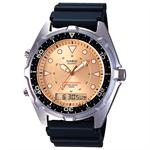 Today, most all quartz watches are analog display (rotating hands display the time). Quartz analog watches are made up of a cell (the power source), a circuit board or electronic module containing a quartz crystal which regulates the timing rate of the watch), and a coil which transfers energy to the rotor which in turn drives the power train of wheels and pinions. The power train is connected to the dial train of wheels and pinions which carry the hands to display the time. The mechanical watch is made up of a power source (Mainspring) and a power train of wheels and pinions like the quartz watch. The energy is transferred to the dial side of the watch and the time is displayed by hands being driven by the dial train.
In the quartz watch the timekeeping rate is governed by the frequency of the quartz crystal which vibrates at the rate of 32,768 times per second and is therefore very accurate. The timekeeping rate of the mechanical watch is determined by the oscillations of a balance wheel which is usually at the rate of 18,000 times per hour. This is much less accurate. The error rate of a quartz watch is usually in the range of 10 to 20 seconds per month, while the error of a mechanical watch of average to good quality is in the range of 5 to 10 minutes a month. Most mechanical watches are either (A) manual wind or (B) automatic (also known as self-winding). As most everyone is aware, winding a manual watch, means turning the crown back and forth as far as it will go. This coils the mainspring to its full power potential. This power is transmitted through a series of gears (called wheels and pinions) to the escapement (escape wheel, pallet fork and balance wheel), which governs the timekeeping rate of the timepiece. It will continue to run as long as there is power transmitted from the mainspring. An automatic watch varies only slightly from the manual wind. It is equipped with a semi-circle shaped weight, which is connected via a set of gears to the mainspring. The movement of the wearer’s wrist causes this weight to rotate and in turn, wind the mainspring.
Winding your Watch:
One thing to note — And this is VERY important: movement of the wrist normally is only enough to maintain the power on the mainspring but not enough to increase it’s potential, therefore, an automatic watch should always be wound fully manually before it is placed on the wrist. This can be done either by shaking the watch back and forth for 120 seconds to activate the oscillating weight and fully wind it, or on some models, winding the crown. One very important thing to remember is that horology is NOT an exact science. There are so many influences affecting the time keeping rate of a watch that consistent accuracy is an impossibility and can never be expected. Another important thing to remember is age affects the rate of a watch as well. As parts wear, the tolerances become less acute and the watches are more prone to positional errors.
Water Resistant Watches:
Along those same lines, we should discuss the subject of water resistance. Many watch owners believe that if a watch says water resistant anywhere on it, they can expect it to never get moisture in it. Water resistance is a very vague area. The watch industry has attempted to define it, but it still is open to interpretation. First of all, there is no such thing as “Water Proof”. There is a point where each and every watch will take on moisture. Some watches resist moisture better than others. Very Important: “Motion is a function of pressure”. A watch labeled as water resistant to 30 meters means that under ideal conditions with NO movement, this watch has been tested to keep out moisture to that depth. In the real world, that watch could possibly leak if you’re swimming or even taking a shower. A watch labeled 50 Meters should be OK for swimming. 100 Meters should be good for snorkeling. 200 Meters for scuba diving, and 1000 Meters for professional divers. Several features affect the water resistance: Watch Gaskets, “O” rings, screw-down type watch crowns, screw-on case backs.
- Watches should be serviced on a regular schedule every 24 to 36 months to remove the old sticky oil and dirt and clean and relube them to keep them running best as possible and to prolong their life.
- The average life of a watch has been found to be 8 to 10 years depending on how often it’s serviced.
- There is no “set” cost for watch repair on any watch for any job. Every watch is different and every job is different. Complexity of the watch, condition of the watch and difficulty of each particular job enters into the price quoting procedure.
- There also is no set price on watch cell replacement. Each watch has a different degree of difficulty and therefore different amounts of time are needed for each one. Also, the more expensive watches are more difficult to deal with. Most owners of high grade watches are aware the cell replacement cost will be significantly higher than that of a lower grade watch. From a survey we’ve taken among our accounts, we have found that cell replacement cost at the retail level varies anywhere from $5.00 to as much as $75.00 depending on the aforementioned factors. Don’t be afraid to charge what your time is worth. Remember, your clients bring their timepieces to you, a jeweler, rather than a Walmart, because they expect a higher degree of craftsmanship and they do expect to pay more for that service.
Suggested Warranties on watch repair:
Overhauls are usually warranted for 12 months. This includes labor only. If a part should break within that time, a replacement part will be installed for the cost of the part only. The labor for installing the part will be waived.
- There is usually no warranty on watch crystals (Swiss Legend has a proprietary “Sapphitek” crystal with 10 year warranty)
- There is no warranty on watch stems and watch crowns
- There is no warranty on water resistance
- Don’t assume or tell the customer that a return or “comeback” will be repaired at no charge. Many times it is found that the cause of the problem is either a broken part or another reason that is not covered under warranty.
Myths and Fallacies About Watches:
- A watch CANNOT be “over wound”. Many times a customer will bring in his or her watch and say, “this is over wound and now it won’t run”. What in fact has happened is that there is a blockage or defect of some kind and when the customer winds it all the way up, it doesn’t run. It has nothing at all to do with it being “over wound”. There simply is no such thing.
- A watch is not and cannot be affected by any person’s “body chemistry”, “body electricity”, “body magnetism” or anything else associated with a person’s body. Nobody is sure where this myth got started (probably from some poor watchmaker who couldn’t properly diagnose a problem and used this as an excuse to his customer), but there is nowhere near enough energy in anyone’s body to affect the timekeeping of any watch. If a customer tells you he or she “just can’t wear a watch” be assured it is the fault of the watch, not the person. Of course there are outside influences that could affect a watches timekeeping rate such as being close to a large electric or magnetic field, such as a hydroelectric plant, but a person’s body contains nowhere near that level of energy.
Other factors that affect the proper timekeeping of a watch are: Extreme temperature changes Abuse of the watch Not winding fully on a regular basis Not fully winding an automatic wind watch before placing it on the wrist The need for servicing (cleaning, lubrication, etc)
- At times, customers will come in with old watches that they would like to sell claiming the watchmaker can “use them for the parts”. Please be assured we do not use “used” parts in any of our repairs.
- One of the oldest myths concerns the subject of “jewels” in watches. I’ve heard of charlatan salesmen actually use the pitch “the jewels alone are worth that much”. Let’s shed some light on this misunderstood area. Whenever there is contact between two metal surfaces, such as the pivot of a wheel and its respective bushing, there will be wear. It was discovered many years ago that replacing the metal bushing with a donut shaped jewel would reduce that wear and allow the watch to run much longer and much more accurately. At first, these “jewels” were made of genuine precious stones (usually sapphires, rubies, or even diamonds). Of course the quality of the stones were not of gem quality but rather industrial quality. As time passed it was found that laboratory created gemstones were just as suitable for the job at a lower price. The cost of the “jewels” themselves is very inexpensive. The time and labor of installing them into the watch movement at the time of manufacture makes the watch more expensive but also much more valuable than the non-jeweled watch. Some of the very high quality watches will have very high quality jewels as part of a highly engraved and polished movement.
Important Things to Remember When Sending in a Watch for Service:
- Communicate well and get to specifics about the problem
- Try and get as much info as possible from the customer about the watch. Ask them what the problem is, if losing or gaining ask how much, etc. The more info the better for diagnosing.
- Please put the value of the watch on the envelope so anyone will know how much to insure for.
- Put a full description of the watch on the envelope.
- Make sure the watches are secure in each envelope and adequate packing material is used if packed in a box.
- Don’t use the term “not keeping time”. Please be specific: running fast (how much), running slow (how much), stopped, etc. Always get as much information as possible.
Some Final Thoughts:
- Remember that even a small bump to a water resistant watch can compromise the integrity of its case and permit leakage. This usually happens when the wearer isn’t even aware of it because the watch cushions the impact rather than the wrist or arm.
- Also, one of the biggest enemies of a water resistant watch is steam. If you put your arm over a pot of boiling potatoes on the stove, we can guarantee your watch will take on moisture!
- If someone brings in a watch that has taken on moisture, try and dry it out as much as possible and then send it in for servicing. Don’t do what one of our clients did: He put a gents Rolex that had a moisture leak in a container of alcohol to keep it wet to prevent rusting and then sent it to us. By the time it got to us, the entire watch was full of alcohol. It had completely stripped the dial of all its paint and coated the entire movement in that sticky mess. It was beyond repair and a new watch had to be purchased as a replacement. (He had good intentions, but…..)
- It’s amazing that watches even function at all given the abuse that they’re given. Try to remember that a watch is a machine. A very tiny machine. Just like your car’s engine, only in micro-miniature. Watches have dozens and many times hundreds of parts all operating in a space no larger than a quarter. A watch has got to be treated with proper care and respect or it will malfunction. Take good care of your watches, have them serviced regularly by trained professionals and they will give you years of dependable service.

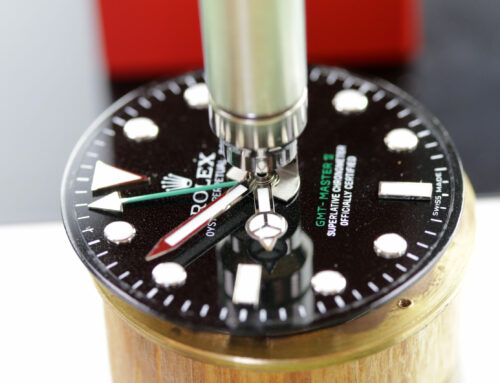

armani emporio 1677 i need to reataches hands.
to access the dial, face of watch from the back i cant remove the back is a smaller opening than the size of the face,what to do?
Thanks for sharing!
How to check quart watch circut coil voltages